Podcast: Play in new window | Download
Subscribe: RSS
Think fire ants are the worst thing hiding in your backyard? Think again. In this episode of the Peskies Pest Control Podcast, Travis introduces a stealthy new invader that’s rapidly expanding across the Southeast: the Asian Needle Ant. Unlike common yard pests, these tiny, orange-legged insects don’t build massive mounds—instead, they lurk quietly in mulch beds and woodpiles, packing a sting described as ‘liquid fire’ that can pose a serious medical threat. Tune in to learn how to spot their bizarre behavior, avoid their painful sting, and protect your yard from this aggressive ecosystem hijacker.
Podcast Transcript:
Travis: Hey everyone, welcome back to the Peskies Pest Control podcast. I’m Travis, your host. You know, we talk a lot on this show about ants, we talk a lot about termites, uh, little crawling insects like that, and we talk about how they’re nuisances. Uh, you know, the ones that come along and ruin your outdoor gatherings in your backyard, um, or fire ants that, you know, leave itchy bumps on you and your kids’ ankles, you know, when you inadvertently walk through the grass and they, you know, you come into contact with them.
But today we’re going to discuss another pest that’s been making some headlines this spring. You know, so we’re halfway through May at this point, uh, and if you’ve been keeping up with the news, there’s kind of a bit of a new insect in town. And that is the Asian needle ant.
Now, I say new, although this ant has been around the United States for quite a while, um, but the “new” refers to the fact that they are currently exploding and invading across the Southeast. Uh, you know, a lot of experts refer to them as a medical pest, and there’s a very good reason for that. If you’re a gardener, uh, someone who enjoys hiking, uh, if you like to move a little bit of mulch in your backyard, then you need to know who these guys are before you reach into the wrong pile of leaves or dirt.
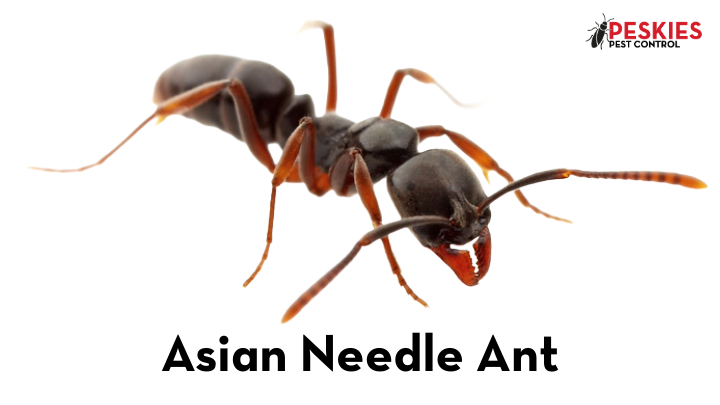
So, you know, you may be asking, “Well, I’ve never heard of the Asian needle ant. What am I looking for exactly?” So, they’re tiny, maybe even about a fifth of an inch long, if that kind of gives you an idea of just how small these Asian needle ants are. Now, as far as color goes, they’re dark, they are kind of shiny and glossy, and almost black for most of their body.
But there’s a dead giveaway that you need to look for when you see these ants, and that is that they have a distinctive orangish-brown color to their legs and their jaws. So, almost a full black body, but their legs and their jaws are orange to orangish-brown. And honestly, you might not even see them coming because, unlike fire ants, they don’t build these huge nests in the middle of your lawn. They’re a lot more stealthy. They do love moist and shaded areas. A lot of times you’ll find them under, you know, rotting wood or logs, even maybe under your stones or pavers in your yard, or way down deep in a mulch bed. You know, they don’t march in long straight lines like a lot of ants do when they make invasions on your house in your kitchen or, you know, in your bathroom. They are more likely to be loners and forage um, on their own, or solo.
And you know, in fact, if an Asian needle ant actually finds a great food source, it doesn’t leave a scent trail to attract other ants. But it actually goes back and picks up another ant and carries the ant to the food with them. Uh, so they’re not communicating with those chemical trails that a lot of other ants leave. So, if you see what looks like an ant with two heads moving across a log or across a mulch bed, then you might actually be spotting this tandem carrying um, that these ants do, which is kind of classic needle ant activity.
One more weird way to identify them is um, if you put them into a glass jar, a lot of ants can climb right up the side of a jar, but an Asian needle ant cannot climb any smooth surfaces. So, if it attempts to climb and it’s sliding down to the bottom of the jar like it’s maybe on a layer of slick ice, you’ve probably found an Asian needle ant.
Now, let’s talk a little bit about why they are referred to as medical pests. So, the sting has been described as liquid fire, uh, or as if someone is driving a hot needle into your skin. But here’s the real danger: the ants are shy. They’re not really aggressive like fire ants that, you know, come and swarm you the second that you step on a mound. So, most stings happen a lot of times when you accidentally trap one, you know, maybe you’re wearing gardening gloves, one of them gets inside, or you lean against a tree where they’re nesting. So, for most of us, it’s just an intense localized pain. Uh, it can actually hurt for sometimes hours.
But for about 1% to 2% of the population, it’s actually a lot worse than that. So, these ants have an incredibly high rate of causing anaphylaxis. Uh, and if you don’t know what that is, it’s a life-threatening allergic reaction um, for people who may be hypersensitive to this interaction with the Asian needle ant. And so there’s uh, people are reporting that, you know, those who have been stung by them, and they’ve lost consciousness within a minute of being stung. So, if you’re already allergic to things like bees or wasps, then you probably have a much higher risk of this reaction.
So, if you get stung, you feel dizzy, have trouble breathing, you end up having a reaction all over your body with hives—don’t wait, don’t put it off. I would say immediately call emergency services, dial 911. Uh, this is not just some sort of, you know, “rub some dirt on it” kind of situation where it’s just going to go away like a lot of times people experience with fire ants. You just want to be extremely careful.
And it’s not just a threat to us; it’s also a threat to our environment in general. So, uh, University of Georgia’s actually done some research and show that in areas where these ants move in, native ants actually disappear. So, uh, they’ve actually done some studies where it looks like about 60% of the native ant population drops in the area where the Asian needle ants move in. And I know you think, “Well, I mean, ants are ants, who cares, right?” So, ants are what we can refer to as forest janitors. They turn the soil, um, they spread seeds for wildflowers. The Asian needle ant doesn’t do anything like that at all. They come in, they dominate, they take over. Uh, they even move into termite galleries um, and force termites out, uh, which sounds like a win for your house, but it completely disrupts the ecosystem of the woods wherever they move in.
So, you may be asking yourself, “Well, what do we do to combat this ant? What do we do to help fix this problem?” So, here’s a couple of things: so clean up debris around your yard. You want to get rid of old wood piles, you want uh, get rid of old thinning layers of leaf litter. You want to watch for excessive moisture as well. So, if you got a leaky outdoor faucet, you may want to get that fixed and stop those leaks because these ants love and crave a damp environment. You know, when you’re out and about, wear protective um, ensembles. You know, thick gloves, closed-toe shoes while you’re working in the garden or moving landscape timbers, um, just protect yourself from the possibility of that interaction.
And then also baiting can help too, um, and this is probably more from a pest control standpoint, although some people do, you know, attempt to do some pest control on their own. Um, but you know, a lot of times in the pest control world with ant baits, we have either sugar-based baits or protein-based baits. So, with these Asian needle ants, standard sugar-based baits a lot of times don’t work because they prefer protein. So, if you’re seeing them, you might need to call a professional who’s got a professional-grade protein bait of some sort to get the job done with them as well.
So, bottom line: the Asian needle ant’s not going anywhere, unfortunately, just like a lot of invasive species that come from other countries. Um, they get here, they take up residence, and they’re here to stay. And as our climate warms up, they’re only going to move further north. So, it’s not about living in fear, it’s about being aware of what’s going on. So, when you’re out and about outside, look for those ants with the orange, orangish-brown legs. Watch out for damp spots or, you know, old wood piles, mulch beds, things like that. And if you’re hypersensitive to insect stings, definitely keep an EpiPen handy if you’ve had one prescribed by your doctor. Uh, if you have a high risk of having an anaphylactic reaction, it’s definitely a good idea to keep that with you.
Um, so thanks for tuning in. Uh, if you think you’ve found a colony in your yard, feel free to reach out to us. And probably not a bad idea to locate and reach out to your local agriculture extensions office—most areas have them. And let them know that you’ve found them—they’re definitely keeping record and track of where these invasive ants are spreading to next.
So, again, I’m Travis with Peskies Pest Control. Stay safe, stay pest-free, we’ll see you next time.