Podcast: Play in new window | Download
Subscribe: RSS
Welcome back to another episode of the Peskies Pest Control Podcast, your go-to guide for keeping your Alabama home safe and bug-free! In this episode, host Travis McGowin dives deep into a phenomenon every Alabamian knows all too well: the dreaded spring termite swarm. Picture a beautiful afternoon right after a rainstorm, only you look at your windowsill and see a shimmering cloud of vibrating insects. Before you slip into total “termite panic,” Travis breaks down the biology of these winged invaders, how to tell them apart from ordinary flying ants, and the critical “red light” warning signs that mean it’s time to put down the over-the-counter bug spray and grab the vacuum. Tune in to learn exactly what to do whether you find these pests inside or outside your home!
Podcast Transcript:
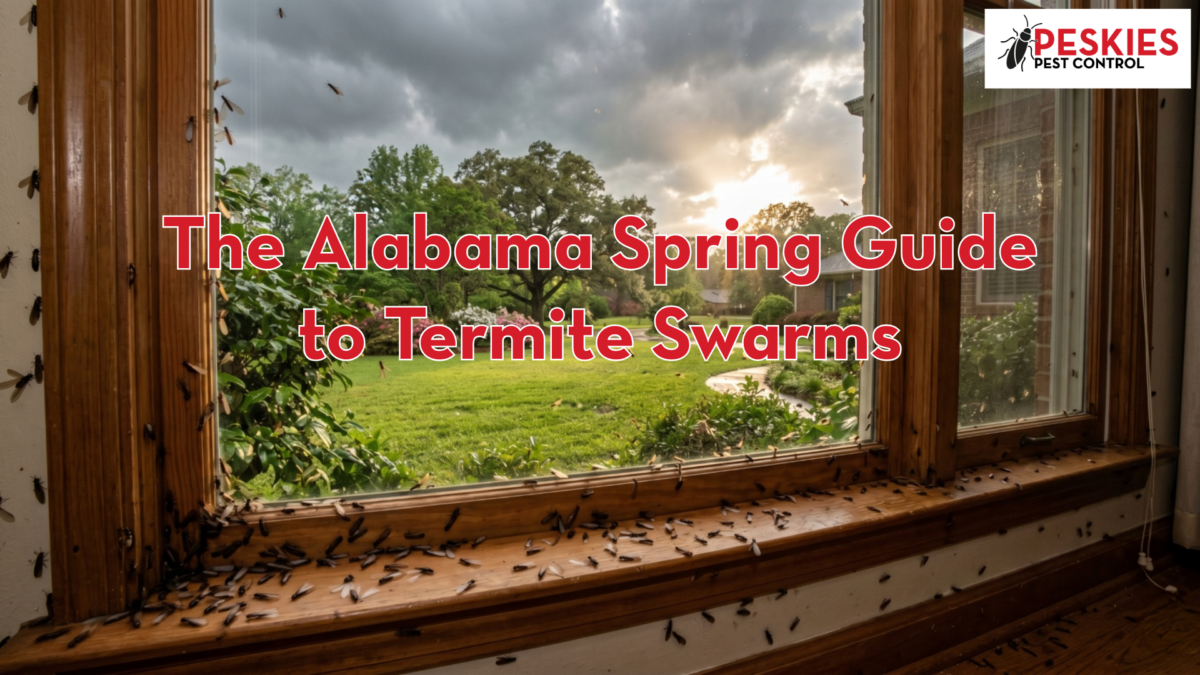
So, I want to give you a scenario. So, let’s just say that it’s a pretty spring afternoon. Storms rolled in, but the rain has just stopped. Sun’s peeking out through the clouds. And you look over to your windowsill to get a glimpse of how beautiful the day actually is becoming. Only to see a cloud of vibrating, shimmering insects on your windowsill inside your home. So, if you’ve lived in Alabama for more than a year, you probably know the feeling of what we will call termite panic. So today, we’re going to talk about the spring swarm. Why is it happening? Is your house currently being eaten, and most importantly, what do you do if you find this phenomenon on the inside versus the outside of your home?
So first off, let’s talk a little bit about termite biology. These aren’t just any termites. These are termite alates. So, think of them as royalty in the termite world. So, they’ve got one mission. The termite colony itself is like a crowded city. So, once it gets a little too full, the colony produces these winged reproductive termites. Their only job, their only reason for existing, is to fly out, find a partner from a different city or colony, and establish a new colony. So, they’re waiting for that perfect weather window, which is usually, you know, a nice, warm, high-humidity spring day, and really after a rain is is uh definitely ideal for them. So, the ground is soft, it makes it new—or excuse me, makes it easier for a new queen to go in and burrow and start to establish that colony. However, they’re terrible flyers. Um they do flutter around for a few minutes, often carried and pushed around by the wind if they’re outside. But if they’re inside your house, they flutter around for a few minutes, they’ll shed their wing—their wings, and then attempt to go to work. So, if you see piles of, you know, translucent termite wings on your porch or on your windowsill, then that means that their nuptial flight is over and they’re trying to start the work of what it is they’re really trying to do.
Now, before you call an exterminator uh in, you know, just a complete and sheer panic, let’s talk about it and make sure that you aren’t looking at flying ants. So, ants do swarm at the same times, look almost identical when you glance at them, but there are a couple of key and important differences that you need to know about to make sure that you identify whether or not it is a termite or an ant.
So, termites have thick, straight bodies. Ants have a pinched waist kind of resembling an hourglass. So, if the body’s approximately the same size from head to toe, or from front to back, I should say, it’s probably a termite. However, ants have that pinched hourglass waist.
The next thing you can look at to identify them is their antennae. So, termites’ antennae, um they’re straight and look almost like they have a bunch of little tiny beads that build their antennae up. If you look at ants, they have elbowed or bent antennae.
And then, another unmistakable sign that can help you identify termites versus ants is the wings. That’s probably one of the easiest ways to tell what it is you’re dealing with. So, termites have four wings that are all equal length in size. Ants, on the other hand, have four wings. However, the front wings are a lot longer than the back ones, so you’ll have two long wings and two shorter wings. Uh so, if the other methods, the the body and the antennae are a little bit too difficult for you to identify, the wings are definitely almost always a dead giveaway.
So, let’s get into what now if you discover this phenomenon, and that depends entirely on where exactly you found this going on.
So, in the first scenario, which would be more ideal maybe, they’re outside. If you see them swarming from a stump in your yard, a fence post, a dead tree, something like that, do not panic. This is a natural part of the ecosystem in the woods around your property. It means that somewhere nearby, you have a mature termite colony and can kind of give you like a yellow light warning. If you picture a traffic light, you know, red means stop, yellow means caution, green means go, this is probably like a yellow light warning. You need to check your foundation for mud tubes, um check the interior and exterior of your house for signs of termites. But mud tubes are kind of like, you know, a line of dried dirt that’s about the size of a pencil, and it goes up the side of the foundation or brick or concrete of your house. You want to make sure you don’t have any of those. Um because that can signify that termites are either already trying to invade your house or have already invaded your house.
So, the second scenario to this would be that you find this phenomenon inside your home. So, if you happen to see these winged alate termites coming out of a baseboard, from around a light fixture, a crack in the drywall, around a window frame, the reality is is that this is a red light. This is a big stop sign. You need to stop, take heed uh because termites are swarming inside your home, and that almost always means that they are coming from within your walls, and they’re trying to get outside to go towards light. So, what I would do in this—in this scenario, if this is you, get you a vacuum and vacuum them up. And there’s going to be a lot of them, so just be prepared. Save a couple in a jar or somewhere where, you know, they’re not going to get away, and call Peskies Pest Control. Don’t wait. Call Peskies Pest Control.
And then, the third part of this, and this is the big one: do not spray them with anything over the counter. No bug sprays. Um, you know, we don’t want to spray them. That spray, whatever you use that’s over the counter, will not reach the colony, will not kill the colony, and it can actually cause them to shut off where they’ve been accessing for the time being and just move to a different part of the house. So, we definitely don’t want that. So, yes, vacuum up these pests. Vacuum them up, save some for your pest control professional, and then do not spray anything on them. You’re going to make life a lot more difficult in getting rid of these termites if you do spray them with something.
So, the bottom line: termite swarmers are just nature’s way of saying, “I’m here, I want to colonize.” If they’re outside, definitely be vigilant. Uh just the other day, I was at a customer’s property doing their termite renewal, checking their baiting system, and while I was around the outside of the house, there were termite swarmers flying everywhere. But, the customer can rest easy knowing that their house is protected. Termites cause billions of dollars in damage every single year. However, like most anything, if they’re caught early enough, they are manageable, the damage can be minimal. So, stay dry. You don’t want to have any moisture—high moisture content or anything that’s going to attract these termites. Keep an eye around your house, especially this time of year, and definitely get your house protected. Uh call Peskies Pest Control. We can come out, we can do a top-to-bottom, thorough inspection to make sure that you don’t already have a termite issue, and then subsequently prevent a termite issue from ever occurring. So, again, I’m Travis with Peskies Pest Control. Thanks, and we’ll see you next time.