Podcast: Play in new window | Download
Subscribe: RSS
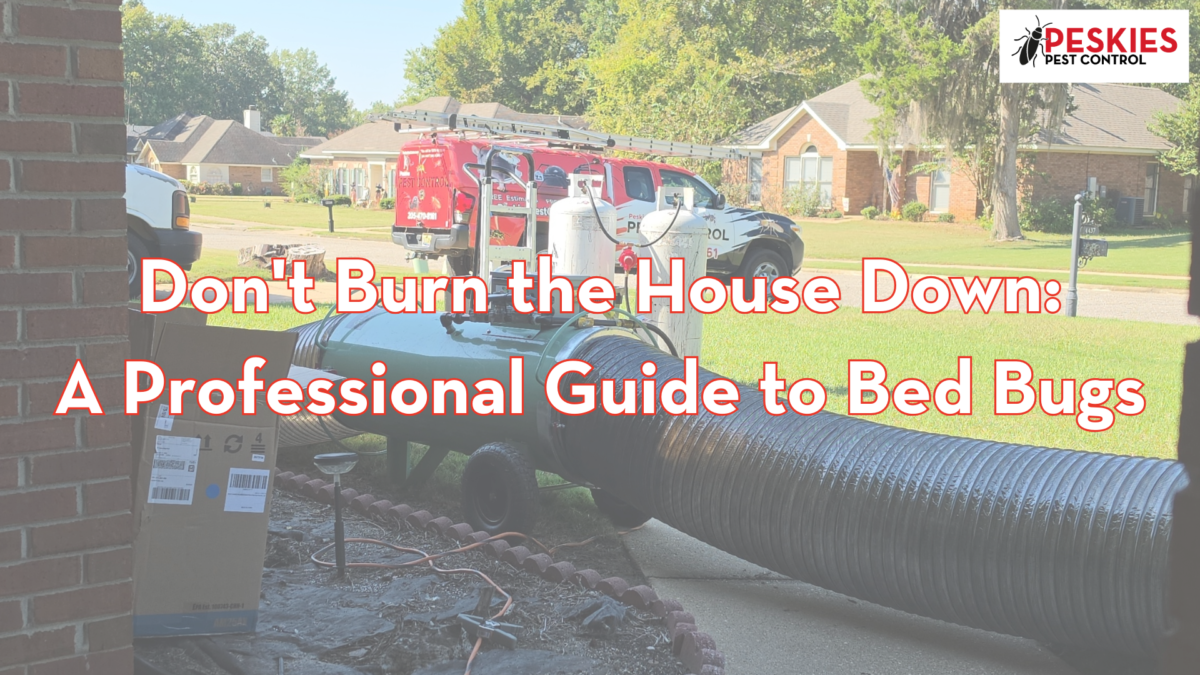
In this episode of the Peskies Pest Control Podcast, hosts Michael Wienecke and Travis McGowin broadcast on-location right outside a residential home in Montgomery, Alabama, where a full-house thermal remediation is underway. From the spike in bed bug infestations following peak travel seasons to the science behind using a 500,000+ BTU propane heater to destroy pests and their eggs in a single day, Michael and Travis break down why heat treatment is the ultimate “one and done” solution. Tune in as they discuss practical travel inspection tips, dismantle the stigma surrounding pest infestations, and share a few hilarious past mishaps involving fire departments and unexpected flea encounters!
Podcast Transcript:
Michael Wienecke: Travis, I feel like bed bugs are on the rise. I feel like we’ve done so many bed bug jobs. I’m losing count.
Travis McGowin: Um, things are heating up. See what I did there?
Michael Wienecke: Heating up! I like that. Yes. Just in case anybody’s listening, we do heat treatments, so that’s why I said that.
Travis McGowin: No pun intended. No pun intended, like I said. But yes, I would say over the last, what, two or three weeks, we’ve done four or five now.
Michael Wienecke: Yeah, and I think it’s due to a lot more people traveling. I just think people are traveling more.
Travis McGowin: Well, and I think you’re going to only see more of an increase in that simply because the holidays are coming up—October, November, December. Peak travel season, people going visiting with their family. You know, the potential of someone bringing something into your house as they come in to visit, or even family members—you know, some families like to take a big family trip for the holidays. Maybe they go, you know, to the mountains or whatever and they stay in a big cabin or something together. Whatever that looks like for their family, there’s definitely a risk that these bugs can travel. Unbeknownst to them, and then of course, when they realize it, a lot of times it’s just too late.
Michael Wienecke: Oh, 100%. I mean, by the time you get them, what, I’d say a month to three months is when they start really showing themselves.
Travis McGowin: Yeah, absolutely. And depending upon what size the bed bug was, what life stage the bed bug was prior to you, you know, bringing it home with you. And for those that don’t know, we’re actually sitting outside of a house right now while we speak that we’re currently doing a heat treatment for. And I think it’s a great place to talk about, because earlier on this morning before we got started, we were interviewing and talking with the owner of the house. And, you know, we asked some normal questions that we ask most clients, which is, “Any idea how you got them? Do you travel?” And that’s the first thing that she said was, “Oh, we travel all the time.”
Michael Wienecke: Yeah, yeah. And the consultation’s so important. I mean, we talk about this in every aspect of pest control, but asking those questions, “Hey, when’s the last time you went out of town? When’s the last time somebody came over?” We’ve had somebody bring bed bugs because their mother-in-law came and stayed for a month. So, unfortunately, unwelcomed guests on both sides can be, can not be great for your home.
Travis McGowin: Absolutely. So, you know, there’s a lot of people who for work or for family, they travel all the time. They have to stay in hotels, they have to stay in Airbnbs or rental properties in general, and they find themselves, you know, at risk—or I would at least say at higher risk than your average everyday human being who’s a homebody. So, let’s discuss a little bit—we’ll talk for a minute here in just a second about what it is we’re doing with this house and how we’re moving the heat in and what it’s doing. But what are some ways that you can mitigate or potentially mitigate this from even being a problem in your own house, especially if you find yourself where you don’t have a choice, you have to travel, you have to move abroad and stay at random places?
Michael Wienecke: Yeah, I’ll tell you what I do. So when I go to a hotel or if I’m out of town or something like that, I hang all my luggage up. Some people put it in the bathtub; that’s also a really good way to, you know, if you’re that worried about it. But I hang everything up, I try to put everything in a hanger in the closet. I do an inspection as well, so looking through cracks and crevices—just a quick inspection of the bed frame, behind the headboard. Doesn’t take that long, about five minutes. If you’re that worried about it, though, I would—if you travel a lot, I would carry, I don’t know the scientific term, but bed bug cups. They go up under the bed frame, and they’ll catch the bed bugs so you’d know right then and there. And then you could just talk to the hotel staff, and I think you’d have a free stay for however long you want.
Travis McGowin: You would definitely be likely relocated to a different room, for sure. But yes, some due diligence when you first arrive at this property—there again, whether it’s a rental house, whether it’s a hotel, whatever it is. A little bit of due diligence, just a few minutes of giving a good inspection around, like you said, the headboard, the mattress. Another really typical hotspot for bed bugs is if you have a window near the bed that has curtains. Looking in those curtains behind them, and especially up towards the top of the curtain where it attaches to a curtain rod above the window. Those are some hotspots that I typically find bed bugs in when I’m doing inspections. So giving it that good look-over can save you lots of money, lots of pain and frustration in the long run, and definitely will ease your mind, for sure.
Michael Wienecke: Well, and a lot of times it’s not even a bed bug that I’ll see; I’ll see a cast skin. And if I’m in a hotel or I’m somewhere and I see a cast skin, that’s a confirmed bed bug as far as I’m concerned.
Travis McGowin: Oh, well, I mean, it had to get there somehow or another. And of course, the only way a cast skin comes is from it being shed from a live bed bug. It would be unlikely for a cast skin to end up behind a bed in a hotel being brought by someone’s luggage or something like that; it would just be very unlikely to happen. So, definitely worth doing the due diligence, and I like your suggestion about hanging things up in the closet. At a minimum, use the luggage rack. Even if you’re not in a position where you can hang stuff up, get that stuff up off the ground. Don’t put your luggage on the bed; don’t put your luggage maybe on top of the dresser or things like that. I would keep my luggage towards more towards that closet, hang it or put it on the luggage rack, and that’ll save you in most cases, too, I would say, unless it was just an extreme infestation where they were in the closet. That would be unlikely, I would say, especially in a hotel.
Michael Wienecke: We’ve seen it.
Travis McGowin: We have, but—
Michael Wienecke: But it’s a really—I mean, you got dead bed bugs and live bed bugs in the top ceiling cracks and crevices of your house by then, so.
Travis McGowin: Absolutely. So, we’re here in Montgomery this morning. Got here around 7:30 this morning, met with the client that owns the property. And of course, we had the interview, like we said a few minutes ago. She said that they travel a lot, they also host a lot of people in, whether that’s family or friends. So they’re not exactly 100% sure where they got the bed bugs. But we can talk about for a minute the setup a little bit and give people a little bit of an idea of what the methodology is, because we’re doing the whole house.
Michael Wienecke: Yes, we’re doing the whole house. I want to go into the consultation a little bit. So this lady was ready to burn her home down! She said—
Travis McGowin: And I quote!
Michael Wienecke: “I will burn it down if we can’t get rid of these.” So that’s one thing that’s so great about the heat and, again, why we chose it, is because you can be back in your home the very next day, where with these other treatments, you have to come, inspect, treat again, and you have to cut off that life cycle, where we are destroying that life cycle all in one 130–140-degree—
Travis McGowin: Absolutely. And anyone who’s listened to any of our content previously knows, and I say it a lot, but there’s no chemical that can penetrate the egg of an insect.
Michael Wienecke: I thought you were going to say “an ounce of prevention is a pound of cure.”
Travis McGowin: You’re going to butcher it every time. “An ounce of prevention is worth a pound of cure.” That goes back to making sure that where you’re staying doesn’t have bed bugs or that you’re putting your luggage where you can’t bring them back. But there’s no chemical that can penetrate the egg of an insect—we’ll specifically say bed bugs because that’s where we’re at right now—but I mean, that goes for cockroaches, fleas, whatever lays their young in an egg. So those chemical treatments historically are going to take longer because you’re killing off life cycles of adult, nymphal stages, and then you’re having to essentially wait until these eggs hatch before you can ever touch them again. So you’re really just prolonging this life cycle development that you’re trying to mitigate, and it can take sometimes months before you can ever get rid of them.
Michael Wienecke: Well, and I’m glad you brought that up. So let me—let’s talk about heat for a second, too, because obviously that’s what we do. Not all heaters are the same!
Travis McGowin: Absolutely. Space heaters from Walmart or a department store are not the same as what we’re using today.
Michael Wienecke: I’ll never forget it when I walked into a nursing home that was infested with bed bugs, and they showed me their heating unit, and it had caught fire several times. And we walked away from that one. But again, not all heaters are the same. I believe you have some oil-heated heaters, I think you have some propane-heated heaters, and then I think you have some gas ones. We use propane, 500,000 BTUs. It cooks them pretty quick.
Travis McGowin: Absolutely. So we have—and if you go on our website or look on YouTube, we’ve got several videos on it, and you can actually see the system that we use. But essentially, it’s a big barrel turned over on its side with a large fan unit that forces air through it, and then of course it has a very large burner on the inside that does shoot flames. We have two large 100-pound propane tanks that we usually hook to this and draw from during the whole treatment. And it forces air across that burner—and I mean, I’m looking at our temperature right now coming out of the barrel of the heater is 250 degrees. It was 280 earlier when we were preheating and getting things up to temp. And she’ll go even higher than that. Of course, we don’t have any desire to burn or damage things.
Michael Wienecke: I don’t know how high it’ll go, and I don’t want to find out.
Travis McGowin: I don’t think we want to test that! But I know that the adjustment knob for the output of the heater—I’ve never turned it all the way up and don’t plan on it, because we’re not here to be destructive, of course; we’re here to just kill bugs. But I mean, right now the barrel temperature says 253 degrees on the nose. Now, of course, we’re running ductwork into the house, so there’s going to be some heat loss. So, you know, if you’re running 250 degrees out of the barrel, where it comes into the house, I mean, you might be looking at 190 coming out of the ductwork. But tell us a little more about the efficiency of this, from how we make this more efficient and maintain temperatures.
Michael Wienecke: So the biggest way is just going to be, obviously, capping off all the cracks and crevices. Depending on the house—this one we were able to do it—but we’re recirculating through. We’re pumping heat through the right-hand side of the house through the window, and then we’re recirculating all the way on the left-hand side of the house, clear across the other side of the home, and pulling that heat. So we’re reusing our heat, and it’s kind of saving us on propane. Not only that, it’s also able to control that heat on a constant source. So it’s more of like a convection oven, if you will.
Travis McGowin: Absolutely. Recirculating is more efficient from a propane usage standpoint, but from also maintaining that temperature in the house. If we did not recirculate this heated air through the structure—and Michael and I have seen this firsthand, which is why I would say 99% of the time we’re going to recirculate unless it’s just absolutely not an option—what happens is that fan that’s inside the barrel of that heater forces air into the structure and creates positive pressure. So if you didn’t pull the heat out of there recirculating, then what would happen is that it would force its way out of some gap or crack or crevice, and you would, for one, push heat out of the structure instead of pulling it through our ductwork and recirculating. And it’s just not going to heat as efficiently. If you’re pulling, let’s say, it’s 85 degrees outside and you’re pulling 85-degree air into this heater, well, the heater’s having to work harder to heat the air. You’re forcing it into the structure, it’s blowing back out because it’s positive pressure, and then you’re using more propane as well. It’s just not efficient. So we want the house to heat as efficiently as possible, and it’s actually, you know, we’ve been cooking now for, let’s see, it’s 11:00, so what, two and a half, three hours now?
Michael Wienecke: We’ve been cooking. Yeah, so a good thing to bring up there, too, is you can’t just come in here and heat the house up to 300 degrees all in one setting. It has to be a very slow—and I’m emphasizing on 300 degrees; obviously, we’re not going that high—but we can’t just push all this heat in in one setting. It has to be a very slow, methodical way that we set up our fans. We have a great YouTube video on that, but we set up our fans, and we’re trying to create—is it a Venturi effect?
Travis McGowin: Vortex.
Michael Wienecke: Vortex, yeah.
Travis McGowin: I guess it’s similar, but Venturi usually refers to water.
Michael Wienecke: With water, yeah, yeah. Bringing my firefighter knowledge in as well. But yeah, so we want a vortex. We want every room to kind of swirl and create almost like a tornado of heat. That’s going to be the best way to get rid of these guys.
Travis McGowin: Yeah, absolutely. And so think of it, with the holidays coming, we’ll use the reference of a Thanksgiving turkey. So if you have a turkey that you have thawed out and you’re ready to cook it, and you put it in an oven, and let’s just say you, for some crazy reason, have that oven at 450 degrees, and you stick this turkey that’s what, let’s just say 50 degrees by the time you put it in the oven—you’ve thawed it out and you’ve let it sit to try to get closer to room temperature—but you put it in at such a high temperature, you’re going to cook the outside well before the inside’s done. And so we try to look at it like that. I mean, you have all the contents in the house: you have beds and mattresses and box springs and headboards, you have couches and chairs and all of these different things. Plus, you’ve also got the floor, the walls, the ceiling—
Michael Wienecke: Wine bottles!
Travis McGowin: Wine bottles, yes, which are prone to leak when they get hot. Or explode. Yeah, anything pressurized. But you’ve got all of these things slowly absorbing the heat that you’re putting into the structure, and you want it to absorb. You don’t want to cook the outside of a couch, but the inside never gets hot enough. So you’ve got to really circulate the heat, you’ve got to start it at a decent temperature, you don’t want to start it too high. You want everywhere that these bed bugs could potentially go to hide to be hot. You don’t want them to be able to escape that heat anywhere. And eventually, you know, I would say at 150, 160 degrees in the house, I mean, it’s almost instant kill on any surface that they touch.
Michael Wienecke: Well, and something else I’ll say that’s kind of a bonus for this is not only are we killing bed bugs, but we’re getting rid of any odor that’s in this house. If you smoked in the house, if a dog used the bathroom for a couple years in the house, it can get that odor out.
Travis McGowin: Yeah, so heat’s going to cause those molecules, whatever that odor molecule is attached to, the heat is going to lift it. And Michael and I can attest—
Michael Wienecke: We’ve done smokers’ houses, and they don’t smell anymore.
Travis McGowin: Right, but when you go in to check the temperatures every little bit, I mean, it dang near burns your eyes.
Michael Wienecke: Oh, you’re off-gassing. Everything’s off-gassing, because everything has an ignition temp. So that may be 190 degrees that that table’s going to catch on fire, where that blanket may catch on fire at 145 degrees.
Travis McGowin: Right, right. So it’s definitely a science to it. From a temperature control standpoint, from a circulation standpoint, it is definitely not going and buying a run-of-the-mill heater and sticking it in a room and hoping for the best. I think a lot of people think that just heat in general is going to solve the problem. But if you went and bought one or two or even three space heaters and stuck them in a room—
Michael Wienecke: You’d burn the house down.
Travis McGowin: Well, for starters, a lot of these space heaters have a safety temperature; they’re going to cut off at a certain point anyway, and for good reason. But even if you had one that didn’t, you’re not circulating the heat. So you may heat the front face of the bed, but you’re not going to get it all the way around the mattress, so the bed bugs, when they start to get hot, are going to move. And so you’re just not going to get the kill that you’re looking for with household items like that.
Michael Wienecke: No. And I mean, these guys can get in cracks and crevices, like you said, behind wall voids, behind outlets, behind picture frames. I mean, they can get—you’ve seen them in a counter crack and crevice at a gas station before.
Travis McGowin: Yeah, in the countertop at a gas station, and I think that was one of the employees that brought them in her purse or something like that. You know, and it’s funny, too. So let’s talk a little bit about the stigma surrounding bed bugs.
Michael Wienecke: Yeah, and the customer today brought that up, you know? She was like, “We’re not gross people, we don’t know how we got it.” And that’s one thing that I really want to emphasize is that it’s not—no pest issue is really brought on by just being gross. Like, a rodent can get in your home just like a bed bug can get in your home. We could get it just as much as anybody else. However, if you go looking for things like used furniture off the side of the road—I was doing a bed bug job over in Pelham the other day, and a guy, all the stuff that they were throwing away was on the side of the road, and he pulled over and started looking at the furniture!
Travis McGowin: Ooh.
Michael Wienecke: And I was about to say, “I wouldn’t touch that.”
Travis McGowin: I should have stuck a business card in the frame of the bed! But funny story, actually. We did a bed bug job a few years ago, and occasionally—and you’ve seen this, too—customers got fire alarms, smoke detectors. The heat treatment can set them off. I don’t think it’s necessarily the heat as much as it is the blowing around of dust and objects in the air. But we were at this one house treating the entire house. It was hot—I think June or July, hot outside, hot inside. And so we were sitting in the front yard under the tent in the shade cooling off after just checking the temperatures, and I could hear the smoke detectors start to go off in the house. I just went in there; I know the house is not on fire, of course. As we always do when something like that happens, we always go ahead back in and take a look and make sure nothing’s going on, and nothing was. And I told the other technician that was there with me, I said, “Get ready for the sirens.” He just kind of laughed, and sure enough, about 30 seconds to a minute later, you could hear the sirens from the fire engine coming that way. So obviously, they had not shut their alarm off or put it on test mode like we had asked, and the fire department was headed our way. So I stood up when they came around the curb, and fire truck pulls up. You and I have done this many times. People are slinging all their gear on, packing out, everything else. And I walk up to the officer’s side of the truck, and he had opened the door, and I looked at him and I said, “Hey man, the house is not on fire; we’re doing a bed bug heat treatment.” And he grabbed the door, looked at me, slammed the door back closed, and they left! Because they were not in any way, shape, or form about to walk into that structure!
Michael Wienecke: I don’t blame them a bit! I wouldn’t take bed bugs back to the station.
Travis McGowin: Right, which I just thought was hilarious. Now, should they have gone in and investigated? Probably, but they saw all of our equipment and everything else, so I think they knew we were legitimate. But it was still funny to me.
Michael Wienecke: Oh, yeah! I’ve had the fire department show up on multiple different jobs in Birmingham, Homewood, Hoover… We’ve been doing this a lot.
Travis McGowin: Absolutely. It’s inevitable. There again, we try to ask the customer, “Do you have a fire alarm with your smoke detectors?” Most people just have smoke detectors with no monitoring. But if you have monitoring, you need to call your monitoring company, you need to get it put on test mode or paused for the day so that we can do what we need to do. And then that way, we’re not triggering emergency services that could be potentially helping someone else. But just the look on his face when I said “bed bug heat treatment” was priceless. Everybody jump back in the truck and left, and they did not come back. And I think we called the homeowner and asked them, “Hey, you need to call your alarm company again.” “Oh, I already did.” “Well, you need to call them again.” And we set the alarm off again at some point, and they never showed back up, so I guess it worked.
Michael Wienecke: They put themselves on test!
Travis McGowin: Yeah, they were like, “We’re going to write that address down; we’re not going back there today.” But anyway, it was quite entertaining, but that just shows you, going back to the stigma—had they walked in and investigated the house, would they have taken bed bugs back to their station? Absolutely not. It’s just the fear of knowing that they’re there. We do inspections, and we’ve never taken them back. The only thing I’ve ever taken back to my house is fleas.
Travis McGowin: I have taken—oh lord, I hope my wife doesn’t listen to this—I have taken fleas back…
Michael Wienecke: German roaches?
Travis McGowin: Oh, no, no, no! But I have taken fleas back to my house one time. I had a really, really bad infestation at an apartment complex here in Montgomery that we no longer service. The single worst I have ever seen, it was that bad. And so I noticed throughout the day as I looked down at my pant legs while I’m in the truck, there’s fleas. So what I’ll do is usually just pick them and throw them out the window.
Michael Wienecke: That’s a lot of picking!
Travis McGowin: It was. So I got home and went into my master bathroom to change. And when I changed clothes, I put some shorts on and noticed that there were fleas jumping on me, which evidently what I think happened was they got down into the cargo pockets in my pants. So I immediately took my pants and threw them in the bathtub, and could see fleas bouncing in the bathtub. And I immediately got product to treat the bathroom, and the wife was none the wiser. So this will be proof as to whether or not she listens to our podcast as to whether or not I get accused of bringing fleas into the house!
Michael Wienecke: See, we were in Bluff Park and I brought them. That’s when we were living in Bluff Park and I brought them, and I told my wife, and we vacuumed and we treated and we got rid of them.
Travis McGowin: Thankfully, it was limited to the bathroom, which was the hard floor, and thankfully I had the reaction enough to throw them in the bathtub. So the one or two or three that I had on me from outside the bathtub, I disposed of, and then I treated the bathtub, washed the clothes, and never had another problem. So I didn’t have to go full-scale flea treatment like we do with most houses. But it is a risk or hazard of the job: bed bugs, fleas, German roaches. There’s always the potential there, but that’s the only time I’ve ever brought something home in six years now.
Michael Wienecke: Well, fleas are pretty common. And maybe that’s what we’ll talk about on our next podcast. But one thing back to the bed bugs, I want to emphasize this, is this is one of those things, you know, we try to preach that you can do some of this stuff yourself and you can control this yourself, but I personally would not recommend anyone doing this themselves.
Travis McGowin: Not a heat treatment. Definitely not a heat treatment. I think that that is a risk-reward sort of deal if you really want to look at it that way. We as a company understand the risk of how we’re doing this. We also understand the payout and the rewards of it and how effective it actually is.
Michael Wienecke: And you get a warranty! We give a 90-day warranty.
Travis McGowin: Absolutely. And not only that, but we have the appropriate items to do it. We show up with the appropriate items, and we’re definitely not showing up with anything from a department store. Our system was specially made, specially ordered out of California—GreenTech Heat. And so I definitely get concerned when people hear, “Oh, well, all you got to do is apply heat.” Well, that’s part of it, but it’s the appropriate temperatures and the appropriate application and circulation of it for the appropriate time. And that’s something that space heaters are just not going to give you.
Michael Wienecke: Well, you’ve got to get enough pressure and enough of that Venturi or recirculating or whatever you want to say around—
Travis McGowin: Vortex.
Michael Wienecke: Vortex, excuse me! I’m on two different wavelengths right now. I’ve also been up since 3:00 AM, so. But you’ve got to get that to be able to do, again, that convection is just so important, because if you’re like National Lampoon’s and you cook that turkey where it just pops open dry, it’s not going to solve your problem.
Travis McGowin: No, absolutely. Like I said earlier, there’s a science to it, there’s a method to it, and it is very, very effective. That’s why as a company when we started discussing the treatment of bed bugs and if we were going to do that, that was why from day one we went ahead and opted for heat. We have never tried to do this any other way.
Michael Wienecke: No, and I wouldn’t, because if I had bed bugs in my personal home, I would want them gone at the snap of a finger, and this is as close to that as we can get.
Travis McGowin: Absolutely. So again, if you have bed bugs or you think you have bed bugs, today we’re in Montgomery, tomorrow we might be in Birmingham or Clanton or Auburn or wherever else that we’re licensed to treat in—
Michael Wienecke: Whoa, we’re licensed everywhere to treat! All 50 states!
Travis McGowin: Well, that’s the good thing about the heat treatment is that it’s not a chemical treatment.
Michael Wienecke: I’m waiting for like a Hawaii phone call, you know, something we can go on a little trip.
Travis McGowin: Yeah, load it up on the Peskies airplane, right? But no, if you find yourself in the predicament of thinking that you have an issue with bed bugs, give us a call. If you’re in Birmingham, (205) 470-8161; if you’re in Montgomery, (334) 595-9055. Let us come out and take a look, let us discuss your treatment options, let us be the provider of relief for you and your family. One-and-done treatment: start that morning with bed bugs, come back home that evening with no bed bugs. We also offer very convenient financing options for those that qualify, so we try to make this as painless as possible. You’ve already went through enough anguish having them in your house; we can solve it for you so that you can get a good night’s rest that night when you come back in.
Michael Wienecke: Well, and I’ll say this, too: again, that warranty is so important. And just with every pest problem that we have, there can certainly be flare-ups, and we’re not immune to that. So we have had to do reservices on bed bugs, and we honor exactly what we say. We come back, we retreat, and if they’re not satisfied, we come back until they’re satisfied.
Travis McGowin: Well, guaranteed. It’s on the back of every vehicle: you’ll be 100% happy or you won’t pay a penny. And that’s the way we are. We’re going to make sure that we do our best work for you, because that’s what we’re advertising and that’s what we give to each and every one of our customers.