Podcast: Play in new window | Download
Subscribe: RSS
Podcast Transcript:
Michael Wienecke 0:00
Hey, and thanks for listening to the Peskies Pest Control Podcast. I am Michael Wienecke, owner and operator of Peskies Pest Control, and I have Travis McGowin. How we doing Travis?
Travis McGowin 0:12
I’m doing well, how are you doing?
Michael Wienecke 0:14
Great man, waiting on the freezing storm to get here.
Travis McGowin 0:19
You know, I all the projections early on were completely devastating, and now it’s like North Alabama. Sorry, but everybody else, you’re going to get wet. It’s going to be rainy. So we’ll see what happens this weekend.
Michael Wienecke 0:34
Well, and then they’re talking about next week. Could be even worse. So we’ll see.
Michael Wienecke 0:38
Yeah, good times.
Michael Wienecke 0:42
Well, today we want to talk about something that hasn’t come up very often, and that’s reinfestation of bed bugs. So we had a customer, after what about eight months of doing a heat treatment, reinfested her home? Right?
Travis McGowin 0:57
Exactly. So initially, the customer believed that they brought bed bugs into their home by purchasing a quilt from a thrift store, I believe is what it was. I think her daughter had gifted her a really nice, handmade quilt that somebody had donated, and she got it home, took it out of whatever packaging was there, and just immediately laid it across the bed. And that’s the only thing that she can think of that was the reason why she was dealing with bed bugs in the first place. And so, of course, we came in, we did an inspection. She had a fairly significant infestation at that time. It’s a two story house. The, you know, the lady lives by herself, so the upstairs really not even utilized. So we, we treated the first floor. And you know, for all intents and purposes, everything was was really good after treatment up until now.
Michael Wienecke 1:57
So let’s talk about the initial so you said she brought a she bought, or she thought she bought a quilt, brought it in and it had one bedbug on it. How? How bad was the infestation when you inspected the first time?
Travis McGowin 2:11
So I can’t confirm or deny how many bedbugs were possibly on that quilt when it was brought in. However, I can say that when we did the inspection, it was, it was fairly significant with bed bugs in cracks and crevices on the headboard and the frame of the bed, as well as on the box springs and the mattress. So, you know, it’s, it’s possible that she may have had them and not known it prior to the actual quilt itself being brought in. But you know, it’s hard to tell, especially if you, you know, haven’t paid attention to it, or hadn’t noticed it until it was too late.
Michael Wienecke 2:48
Well, I mean, they’re, they’re designed to hide in the tightest crack and Travis. I mean, you’ve seen them, you know, at the gas station, between the little pump joints before.
Travis McGowin 3:00
I mean, I have seen them at a gas station, inside of the little booth where the the cashier sits, you know, and rings people up for gas and for convenience store goods there inside a cracker Travis, where a lady that worked there had brought them in her purse and set her purse on the counter, and someone had complained about getting bitten by a bed bug there at the gas station, and lo and behold, there was one bed bug in a very little crevice in the countertop. So they do get around.
Michael Wienecke 3:31
Well, and that’s what I kind of wanted to talk about, how hard they are to detect. I mean, you know, one or two bed bugs within not knowing that and then a month goes by, and then you start, you’re starting to multiply, get bit all that. I mean, it can turn into a pretty quick, or I would say, a slow infestation, but you’re just not realizing it while it’s happening.
Travis McGowin 3:52
Right, and so, you know, bed bugs can range in size, from the eggs, which are really, really tiny, and then the multiple, you know, nymphal stages, where they grow and then they shed their skin or molt, and then they grow again all the way up into the adult stage. I mean, so they can be a varying range of sizes, I would say, anywhere from the size of a mustard seed all the way up to even maybe close to the size of, just to give people an idea, a watermelon seed. I mean, some of these female bed bugs, especially after feeding and being engorged, can be rather large. So you could see where transferring these bed bugs, you know, from one place to the next, if you came in somewhere and sat down at a restaurant where potentially someone had sat with them in their purse or on their clothing, and they fell off in the restaurant booth, and then you came in next and sat down. I mean, it might be very easy to not even notice that you had transferred these little insects in with you and then inadvertently taking them home. So it’s fairly common and easy to get a bed bug infestation. I mean, bed bugs aren’t selective on whose house they go to. They just know that they need a host, and if they can attach on to someone’s clothing or, you know, say, luggage in a hotel or Airbnb or something like that, then they’ll do it. It doesn’t matter if you live in $100,000 house or a million dollar home. They’re, you know, they don’t discriminate.
Michael Wienecke 5:23
No, not at all. I mean, we’ve seen them in Mountain Brook, Hoover, Birmingham, Montgomery, Helena.
Travis McGowin 5:32
Wetumpka, Prattville, Deatsville. I mean, they’re like I said, they they can be widespread. You can have the cleanest house on the block or the dirtiest house on the block. It really doesn’t matter. Now, you know, with this particular individual we came in, heat treated the first floor of the home, you know, so that included the master bedroom, the living room, the kitchen, the dining room area, all of that we actually, you know, cooked it really, really well, of course, up to the manufacturer’s recommendations for the system that we use. And then everything was perceived by the owner of the home to be fine for, you know, a very, very long time. And then what basically happened next is, you know, eight months later, we have this. She said that she had went to get a blanket and change her sheets out on the bed, and she noticed a bed bug at that time. She kind of was speculating whether the bed bugs could have been hiding in the sheets in the closet or something like that. But what I’d like for people listening to realize is that it’s not likely that that would have been, you know, the issue of reinfesting because they were hiding in the closet or something, eight months later. So, you know, of course, bed bugs, depending upon their size and how long they are in their development, bed bugs can last a decent amount of time without feeding on a human or having a blood meal. You know, for everywhere from the this sounds terrible to say, but the newborn stage and the younger nymphal stages all the way up to the adults. The younger nymphal stages aren’t going to last without a blood meal more than probably, like, two weeks, give or take. And as they grow in size, they’re they’re gonna last a little bit longer to where the adults, you know, may last. Let’s just say six weeks, eight weeks, something like that. But definitely not to the tune of seven or eight months before they feed again. I mean, most of that population would have have died off, even if they were in the closet. So, you know, we kind of ruled that out, you know. And it was frustrating because, of course, you know, we go to do the inspection, and she’s got another significant infestation of bed bugs. So, you know, it does lead us to believe that it was more of an issue of reinfestation, where, I mean, maybe they were in her chair at work, or maybe, you know, in the car. But you know, it’s anybody’s guess as to where they came back from.
Michael Wienecke 8:15
Well, and that’s why we always recommend, you know, leave your purse, leave everything you can in the house that we’re heating because that’s going to give us the best chance to get rid of those bed bugs. So let’s talk a little bit about the heat treatment. You know, how it works, all that kind of stuff.
Travis McGowin 8:28
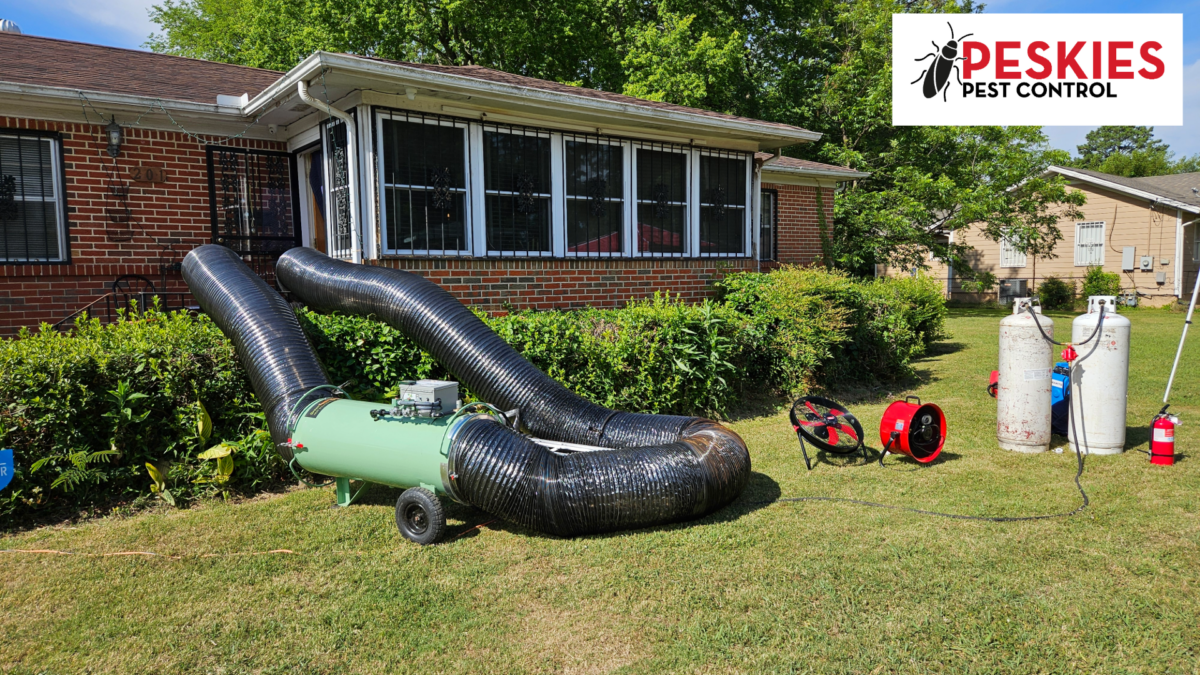
Yeah so we use a propane fired heater, and that heater goes, you know, outside of the house. So, you know, we don’t ever bring propane tanks or the actual unit with the heating element inside, inside your home, but we set up where we have access to run duct work. So of course, we set the heater up connected to all of the propane tanks, and then we run big mylar duct work into the structure, whether it’s through a window or a door, and we circulate that heat into the structure, and then we run mylar duct work from a different point of the structure out back to the back barrel of that heater to recirculate that heat. It’s more efficient. It maintains heat at a better rate. We use less propane, and we heat faster that way. But basically, we run that heat in through the mylar duct works, and then we bring in large fans inside of each room that we’re treating, and we circulate that heat and think of it like an, you know, essentially creating an oven inside your home. Okay, so let’s just say it’s the holidays. It’s Thanksgiving, and you go to put a turkey in the oven. You know that heat is going to be circulating around and moving around inside that oven and cooking the, you know, that Turkey, or whatever it is you’re cooking, and it’s going to slowly absorb into the food that you’re cooking. And, you know, increase the temperature of that to, you know, whatever the set temperature or your desire to. Temperature is to cook at, and it’s very similar that heat is going to be absorbed by anything inside the room, the contents that could be couches, chairs, you know, the walls, the ceiling, the floor, anything in between. And after those items reach the appropriate temperature, that’s when, of course, we start our timer, and then we cook based upon what our equipment manufacturers recommendations are. And, you know, afterwards, by the time we pull out all of our equipment and leave, the bed bug infestation is gone.
Michael Wienecke 10:33
Yep. And it takes a whole day. I mean, we’re there for almost a whole eight hours.
Travis McGowin 10:40
Yeah, absolutely. And you know that’s, of course, size dependent upon the structure. If we’ve got a structure where we’re treating two floors upstairs and downstairs, or just a very massive layout in terms of, you know, the floor on the first floor, it can, it can take a significant amount of time. And then, of course, you know, what the homeowner needs to realize or remember, is that when you come back into that structure after we’re done there again, we turned your home into essentially an oven, it’s going to be relatively warm for a while as that oven cools off, no different than when you take the turkey out of the oven and turn the oven off at Thanksgiving, and that oven is going to be warm for quite a while before the heat dissipates and cools off and then reaches room temperature again.
Michael Wienecke 11:27
And that’s what’s so great about the heat treatment, is that, you know, it’s just, it’s kind of like you said, warming up everything at one time, and then it’s slowly radiating heat into other things. So you’re getting an internal temperature to kill those bed bugs in every inch of that home.
Travis McGowin 11:43
Well, and bed bugs are very good at hiding. I mean, they didn’t, they didn’t, you know, stick around for this many years because they were bad at hiding. So, you know, if you had, like, a metal bed frame that’s hollow, you know, hollow tubes that make the frame and that’s got gaps or cracks in it where the joints come in. You got to think that bed bugs can get down into those spaces. So that heat being absorbed into furniture and into the room itself is great because it’s going to get to those places where, say, a normal chemical treatment may not be able to reach, and it’s really the quickest, most efficient way to kill a bed bug population, from egg all the way to adult in, you know, just a few hours, as opposed to going for weeks at a time applying a liquid product, having to wait for those eggs to hatch. Because, of course, no chemical product can penetrate the egg of a bed bug or any insect for that matter. Until it hatches, those eggs are safe, usually, but heat is a whole different story. It cooks them before they ever hatch.
Michael Wienecke 12:52
Nukes, the whole family.
Travis McGowin 12:55
Yeah, that’s, that’s a good way to put it, you know. And it’s what’s also is amazing. It’s good that you’re heating all the surfaces and the contents in the room, because when the increase in temperature begins, and you and I, Michael, have seen it when we go on site to do these treatments, but when those increase in temperatures begin, those bed bugs that are, you know, able to move, that haven’t hatched, or that have hatched already, they start to move, looking for a place that is cooler for them to stay, so that they can survive. And as you know, when you’re heating all those contents and all those surfaces, they don’t have anywhere to go. It’s pretty wild sometimes, and sometimes you don’t even realize how significant an infestation was until you start to crank the heat up, and then they all start to move.
Michael Wienecke 13:41
Out of the woodwork.
Travis McGowin 13:42
Yep, I had a college, two college dorm rooms that I treated. And you know, I saw bed bugs when I did the inspection, but when I started to turn the heat up in that dorm room, or both those dorm rooms, it was mind blowing how many bedbugs were actually in this empty, vacant dorm room with, you know, two, two beds? I mean, it was just amazing. You would have never guessed there were that many, but they started coming out of the woodwork trying to find a cooler place to go,
Michael Wienecke 14:12
Right. Well, and I’m glad you brought that up about chemical and heat, and that’s why we chose heat. Is because heat is just, it’s, faster, in my opinion, in our opinion, it’s more efficient. We’re not having to go back 2, 3, 4, or five times. We’re not having to worry about a reinfestate or, you know, one surviving and reinfesting the home, anything like that,
Travis McGowin 14:35
Right. And you know, there’s only so much that us as a pest control provider can actually control in terms of reinfestation. So for example, if you’re going to work in a place that has a known bed bug infestation, and let’s just say you brought them back to your house, your house was treated, your house was cleared. Obviously there’s a huge potential there to reinfest and so you know, if you find yourself in that situation where it’s like, okay, I can’t live peacefully in my own home, in my own space with bed bugs, but I still have to work in a place where there’s a high potential to bring them home, then there’s really some precautionary things that you probably need to be doing when you come home from work, for example, immediately removing those clothes and laundering them every day. The less amount of personal items, such as a purse or bags or anything like that, trying not to take that stuff with you, you know, because things can crawl in there, and then, you know, hitch your ride home with you. There’s just, like I said, there’s just several different things that you might want to look at doing if there’s a high potential to bring them back with you to reinfest your home.
Visit us on YouTube! Click Here!
Visit us on Facebook! Click Here!
Learn more about bed bug heat treatments! Click Here!